How spaced repetition works
You review a fact right before you would have forgotten it, and each time you get it right the next review moves further away. That's the whole idea. The rest is arithmetic.
What spaced repetition is
Spaced repetition is a review schedule that spreads your practice over widening gaps of time instead of packing it into one sitting. You see a question, answer it from memory, and depending on how that went the app decides when to show it again. Get it right and the gap grows: one day, then three, then a week, then longer. Get it wrong and the gap collapses back down.
The forgetting curve
Memory for something learned once drops off sharply, then flattens. Hermann Ebbinghaus mapped this in the 1880s, memorizing lists of nonsense syllables and re-testing himself hours later, then a day, then days. The shape is the forgetting curve: steep loss early, a long slow tail for whatever survived.
What matters is what a review does to the curve. Each time you pull something back out of memory, the curve resets and comes down more gently than before. So a fact recalled four times over two months is genuinely more stable than one recalled four times in an afternoon, even though the count is the same.
That effect — the same study time producing better retention spread out than massed together — is the spacing effect, one of the oldest and most replicated findings in the psychology of learning.
Why rereading and highlighting feel productive
Rereading and highlighting build recognition, not recall, and the two feel identical from the inside. A paragraph read for the third time goes down smoothly, and your brain reads that fluency as knowing the material. What you actually know is that the sentence looks familiar — and the exam doesn't hand you the sentence. Highlighting is worse: you mark a passage important and move on, having done no work on the content.
This is why people who "studied for six hours" go into a test and blank. The six hours went into reading, not remembering.
Active recall is the mechanism
The retrieval attempt is what strengthens the memory, not the answer you see afterward. People flip a card, glance at the back, think "yeah, I knew that," and move on.
Produce the answer before the back is visible. Say it out loud, write it down, or at minimum commit to a specific answer in your head. If nothing comes, sit in the blank a couple of seconds before flipping. That gap is uncomfortable and it's where the work happens: effortful retrieval strengthens a memory more than easy retrieval. It also means you find out what you don't know now, not the night before the exam.
What an interval is, and why it grows
An interval is the number of days until a card is next scheduled to appear. First correct answer: about a day. Right again: about three days, then a week, then two weeks, then a month, stretching from there. The exact numbers depend on the algorithm, but the shape is always the same — multiplicative growth, not a fixed weekly review.
The growth is the point: a card that survived a long gap will probably survive a longer one, so retesting it early is wasted work. It's also the answer to "won't this take forever once I have 900 cards?" No — a card you've held four months comes up every few weeks. What you review each day is mostly the last two weeks of material.
What happens when you fail a card
Failing a card resets its interval and brings it back soon — in most systems, before the session ends. It isn't a punishment; a failure is the system finding a gap that was already there. Two things worth knowing:
- Be honest about the rating. Rate a card Good when you actually guessed and the schedule will treat a weak card like a strong one. The algorithm only knows what you tell it, and you'll find out when it matters.
Fitting it into a real week
The schedule only works if you show up most days. The design question is how to make a short session unavoidable, not how to make a perfect one:
| Problem | What to do |
|---|---|
| You skip days | Attach the session to something you already do daily — the bus, the first coffee, the ten minutes before your first class. A fixed slot beats a resolution to "study more." |
| Sessions are too long | You made too many cards, or your cards are too big. Aim for one fact per card. Twenty minutes is about the size of session that survives a bad week. |
| You fell behind and there are 300 due | Don't try to clear it in one night. Do a normal-length session daily. Most of those cards are ones you still know, so the pile drops faster than it looks. |
| Exam in nine days | Keep the daily reviews and add focused passes over that subject. Spaced repetition handles retention; it does not replace working practice problems. |
Reviews are due on a date, not a time, so a card due Tuesday is fine at 7am or 11pm. Missing a day by a few hours breaks nothing; missing three weeks means a big pile, not a lost deck.
How Reps does it
Reps runs SM-2. You flip a card, answer in your head, then rate it Again, Hard, Good, or Easy. That rating is the only input, and from it the algorithm sets the next date for you.
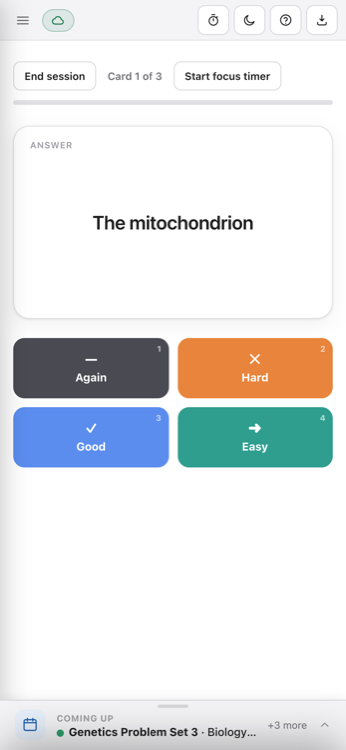
Rating a card Again sends it to the back of the current pile — you see it again before the session ends, not tomorrow. The full mechanics, including how the ease factor moves, are on the SM-2 algorithm page.
Get Reps on the iOS and macOS App Store
One payment of $6.99 USD, or $6.99 CAD in Canada, covers iPhone, iPad, and Mac, and the Reps home page covers the rest of the app. If you're memorizing drugs, pathways, or lab values, flashcards for medical and nursing students covers what to card and how to build the deck.
FAQs
Does spaced repetition actually work?
Yes, and it is unusually well evidenced. The spacing effect — the same total study time producing better retention when spread out than when massed — has been replicated since Ebbinghaus first measured it in the 1880s and is one of the most consistent findings in the psychology of learning. What is still argued about is the optimal schedule, not whether spacing beats massing.
How long should I wait between reviews?
About a day after you first get a card right, then about three days, then a week, then two weeks, then a month, stretching from there. The shape is always multiplicative rather than a fixed weekly review. You do not calculate this by hand; the app sets each date from how you rate the card.
Is spaced repetition better than cramming?
For anything you need past the exam, yes. Cramming puts material into a briefly accessible state that holds for a day or so, which is why it works when the test is tomorrow. It does not survive a week, because there is no second review to flatten the forgetting curve. Four hours the night before and twenty minutes a day for twelve days are the same four hours; only the second one is still there in March.
Do I have to review every day?
Most days is enough. Reviews are due on a date, not a time, so a card due Tuesday is fine at 7am or 11pm, and missing a day by a few hours breaks nothing. If you miss a week the cards wait for you as a backlog — run normal-length sessions daily rather than trying to clear it in one night, because most of that pile is material you still know and it drops faster than it looks.