How to write flashcards that actually work
Most people who quit flashcards didn't quit because the method failed. They quit because their cards were unanswerable, and answering them felt like being punished.
A bad card looks fine when you write it. You've just read the chapter, everything is fresh, and the card seems obvious. Four days later it's a wall of text with a question hidden inside it, and you sit there for forty seconds trying to work out what it's asking. You rate it Again, then do that eleven more times over the next two weeks. The fix is almost always in the writing, not the schedule.
One idea per card
Each card should ask for exactly one piece of information. This is the minimum information principle. If your card has four things on the back, you will miss one of them, and missing one means the whole card comes back — including the three parts you already knew cold.
Say you know each of those four facts 85 percent of the time. The card as a whole comes out right about half the time. It sits in your daily count forever, and it feels like the material is impossible when really you just built a card that can't be passed.
Before
Front: The nephron
Back: Glomerulus, Bowman's capsule, proximal convoluted tubule, loop of Henle, distal convoluted tubule, collecting duct. Filtration happens at the glomerulus. Most reabsorption is in the PCT. The loop of Henle sets up the medullary gradient. ADH acts on the collecting duct.
After — four cards, each with one answer:
Where in the nephron does filtration occur? → Glomerulus
Which nephron segment reabsorbs the largest fraction of filtered sodium? → Proximal convoluted tubule
Which nephron structure establishes the medullary concentration gradient? → Loop of Henle
ADH increases water permeability of which segment? → Collecting duct
That's four cards instead of one, and it's less work, because each passes or fails on its own and the ones you know drop out of rotation fast.
Why copying a slide onto a card doesn't work
A slide is designed to be read while somebody talks over it, and a card is designed to be answered from memory in about ten seconds. A screenshot of a slide on the front of a card is still a slide. You read it, it looks familiar, you move on. The exam doesn't show you the slide; it asks a question with a blank next to it.
A 60-slide lecture turned into 60 slide-cards is an hour you'll spend rereading. Sixty real cards from the same lecture is a bus ride. The spacing effect only helps you if what's being spaced is an actual retrieval attempt.
Turn a fact into a question with exactly one answer
The test for a good front is simple: read it and ask whether two different correct answers exist. If they do, the card is broken, and you'll fail it for reasons that have nothing to do with what you know.
Before
Front: Mitochondria
Back: Powerhouse of the cell, double membrane, has its own DNA, site of oxidative phosphorylation
After
Front: Which organelle in an animal cell carries its own circular DNA?
Back: The mitochondrion
Plus: Oxidative phosphorylation happens on which mitochondrial structure? → Inner membrane (cristae)
Before
Front: 1929
Back: Stock market crash, start of the Great Depression
After
Front: In what year did the New York stock market crash that began the Great Depression?
Back: 1929
The original front is a year with no question attached. It could be asking for the event, the month, the president, the resulting legislation. Also note the direction: you almost always want date-from-event, not event-from-date, because that's how exams ask it.
"Why" cards are usually stronger than "what" cards when the reasoning is the thing being tested, and in pharmacology and nursing the reasoning is what gets tested constantly.
Cloze deletion, and when it's the right tool
Cloze deletion means taking a sentence and blanking out one word, then recalling the blank. Use it when the fact lives inside a sentence structure you want to keep.
Cloze that works
The Treaty of Versailles was signed in the year _______. → 1919
_______ nerve injury causes wrist drop. → Radial
Normal adult resting heart rate is _______ to _______ bpm. → 60 to 100 (two blanks, one fact — this is fine)
Cloze that doesn't
The _______ Treaty was signed in _______ at the end of the _______ War by _______ nations.
The failing example has four blanks that are four separate facts. You'll get two, miss two, and fail the card. If a sentence has two facts worth knowing, make two cloze cards from the same sentence.
Use a picture when the thing is a picture
Anything you'd have to describe in words to picture it should be a card with a picture on it: anatomy, histology slides, ECG rhythms, organic mechanisms, circuit diagrams, the bones of the wrist, a map. Converting these into text is a translation step you'll have to reverse under exam conditions.
Before
Front: Name the eight carpal bones in order, proximal row lateral to medial then distal row.
Back: Scaphoid, lunate, triquetrum, pisiform, trapezium, trapezoid, capitate, hamate
After
Front: a hand X-ray or diagram with one bone circled. Back: Scaphoid.
Eight cards, one per bone, same image with a different bone circled each time.
The list version tests your ability to recite a list, and you can recite that list perfectly while still being unable to find the triquetrum on a film.
Don't build sets that only come back in order
If you can only get to item four by counting up from item one, you've learned a chain, and the exam won't start you at one.
This shows up with cranial nerves, amino acids, the periodic table, the presidents, the stages of a process, and every mnemonic list you've ever been handed. The mnemonic gets you the order. It doesn't get you "what does CN VII innervate" when the question skips straight to seven.
Before
Front: List the twelve cranial nerves in order.
After
Cranial nerve VII is called what? → Facial
Which cranial nerve number is the trigeminal? → V
Which cranial nerve comes immediately after the vagus? → XI, accessory
Damage to which cranial nerve causes loss of smell? → I, olfactory
Note the "comes immediately after" card. That's how you keep the ordering information without making the order a load-bearing part of every other card.
Writing a card is your first review
Writing the card is where most of the learning happens. To write a good one you have to decide what the question is, which means deciding what matters, which means understanding the material well enough to separate the tested part from the surrounding text. By the time a lecture is carded, you have been through it properly once — before a single review is due.
Once the cards exist, they travel. Reps exports any subject as a .reps file that opens straight into a classmate's copy, so four of you can take a unit each and swap the files at the end of the week — you write one section and review three, and because you have to actually answer a card to rate it, you read their work as you go. The same file is worth keeping after the term ends: a friend, a sibling, or anyone taking the course next year with the same professor gets a deck built for that exact class rather than a generic one.
How many cards a day is realistic
Twenty to thirty new cards a day is a pace most people can hold through a semester. It sounds low in week one, and stops sounding low around week five when everything you added is coming back on top of everything new. Each card generates reviews for months: add 200 on a Sunday because you felt behind, and by Thursday you've got a review count you can't clear, so you skip a day, and the backlog is worse than the thing you were fixing.
Ten a day is light — the right pace for a language you're keeping warm. Twenty settles into one or two hundred reviews once it builds. Fifty only works with very short cards, and it's the pace I've watched people abandon in week three. Well-written cards graduate to long intervals and stop bothering you; bad cards never leave — two people adding 20 a day can be doing wildly different amounts of work.
The leech problem: a card you keep failing is usually a bad card
If you've failed a card six or seven times, the card is the problem — something about how it's written makes it unanswerable, and repetition won't fix that. These cards are called leeches: they come back constantly, take longer because you sit and struggle, and make studying feel like failure. When you catch one, diagnose it before you do anything else:
- Too much on the back. Most common by a wide margin. Split it.
- The front is ambiguous. You're answering a different question than the one the back answers. Rewrite the front to be specific.
- You never understood it. Flashcards are for retaining things you already understand. If you can't explain the concept in a sentence without the card in front of you, close the app, go back to the chapter, and rewrite the card afterward.
- It's interfering with a similar card. Two drugs with near-identical mechanisms, two dates in the same decade, two Spanish verbs that both mean "to take." You know both words. Under time pressure you can't tell which is which. Rewrite both cards so each one names the contrast explicitly.
- It doesn't matter. Some facts are not worth the seat they're taking. Delete it.
That last option is underused. You can just delete it. Nobody is counting. If a fact is genuinely important you'll meet it again, in a lecture or a problem set or a different card, and you'll write a better version then.
Before — an interference leech
Front: tomar → Back: to take
Front: llevar → Back: to take
After
Front: Spanish: to take, in the sense of taking something in or catching it — a drink, a pill, a bus → tomar
Front: Spanish: to take, in the sense of carrying something to a place → llevar
Plus a sentence card each: Voy a _______ el autobús a las ocho. → tomar
Doing this in Reps
A card can carry a photo on either side, from the camera or your photo library — the textbook diagram cropped to the region, or a photo down the eyepiece for a histology slide. There is a drawing pad too, and Apple Pencil works: press harder, the line gets thicker. Sketching the Krebs cycle skeleton yourself while making the card is a second pass at the material.
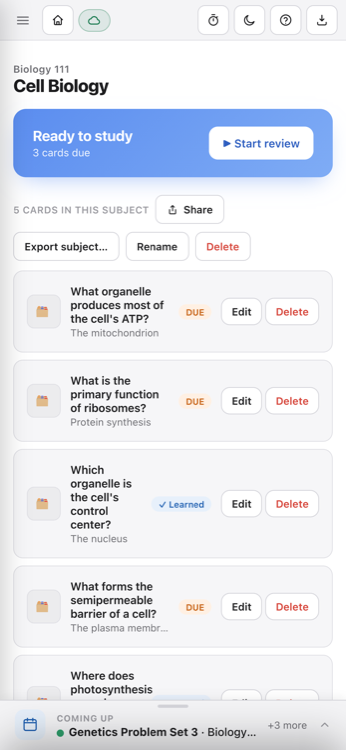
Splitting a bad card is manual: edit the original down to one question, then add cards for the rest. Do it the moment you catch it, because you will not come back to it.
The short version
- One idea per card. Split anything with a list on the back.
- A front with exactly one correct answer. Read it cold and check.
- Cloze for facts embedded in a sentence, one blank at a time.
- Images for anything visual. Mark what you're asking about.
- Ask about neighbors, not whole chains.
- Write your own — then share the deck with people taking the same class.
- Twenty to thirty new cards a day, held steady.
- A card you keep failing is a badly written card. Rewrite it or delete it.
FAQs
How many new cards a day should I add?
Twenty to thirty, held steady, is a pace most people can carry through a semester. The limit isn't the new cards, it's the reviews they generate six weeks later.
What is a leech?
A card you keep rating Again. Six or seven failures and it counts as one. It's almost always a writing problem: too much on the back, or a front that admits two answers. Rewrite it into smaller cards or delete it.
Get Reps on the iOS and macOS App Store
$6.99 USD once, or $6.99 CAD in Canada, for iPhone, iPad, and Mac together. No subscription, no account, no server — your cards sync through your own iCloud and nobody else can see them.