Flashcards for medical, dental, nursing students
You knew the brachial plexus cold in September. It's week nine and you couldn't draw it now. Nothing went wrong. You learned it once and then didn't see it again, and that's what happens.
Reps is a flashcard app for iPhone, iPad, and Mac that runs the SM-2 spaced repetition algorithm. This page is about how to make cards that work for anatomy, pharm, micro, lab values, and patho, and how to lay out a semester so the deck doesn't collapse on you in week nine.
Get Reps on the iOS and macOS App Store
Why the volume is a scheduling problem
You forget on a curve, and the curve is steep at the start. That's the spacing effect. Ebbinghaus was measuring it in the 1880s and it has held up since. Material you reviewed once and then left alone drains away. Material you meet again right as it's getting shaky sticks, and each successful meeting buys you a longer gap before the next one.
A cardio block hands you every murmur, every antiarrhythmic, and the conduction system, and then renal starts on Monday. Nobody holds that by rereading. The hard part is picking which forty facts to look at on a Tuesday night.
That's arithmetic, and Reps does it. You rate each card Again, Hard, Good, or Easy after answering in your head. Again drops it to the back of the pile and it comes back before the session ends, not tomorrow. Get it right and it's back tomorrow, then in about three days, then the interval stretches into weeks — no settings to configure. The SM-2 algorithm page walks through the math if you want it.
The categories that dominate, and what a good card looks like in each
Five categories eat most of the card count in medical and nursing programs, and each one fails differently when the cards are written badly.
| Category | What goes wrong | What to do instead |
|---|---|---|
| Anatomy | Text-only cards asking for a list of borders or attachments. You learn the list, not the structure. | Put a photo or a screenshot of the image on the front with the structure indicated. Answer with the name, then check. |
| Pharmacology | One card per drug holding class, mechanism, half-life, adverse effects, and contraindications. You recall two of five and rate it Good. | Split. One card for mechanism, one for the adverse effect you'll actually be tested on, one for the contraindication that kills someone. |
| Microbiology | Cards that run one direction only — organism to disease. On the exam you get the presentation and have to name the organism. | Write both directions as separate cards. Gram stain, morphology, and virulence factor each get their own. |
| Lab values | Memorizing a bare range with no anchor, so the number floats free of any patient. | Front: "Serum potassium, normal range." Back: the range, plus the one clinical consequence at each end. |
| Pathophysiology | A card that asks you to "explain the pathophysiology of X." Too big to answer, impossible to grade honestly. | Break the mechanism into single steps, each one a card. Then one drawing card that asks for the whole chain. |
The common thread is that a card should have exactly one thing you can be right or wrong about. There's a longer treatment of it on how to write flashcards that actually work, including what to do with cards you keep failing.
Image cards for anatomy and histology
Anatomy and histology are recognition tasks, so the card should show you the thing. In Reps a card can carry a photo on the front, the back, or both, pulled from the camera or your photo library. Photograph the plate in your atlas, screenshot the slide from your histology set, snap the whiteboard your lab instructor drew on.
The pattern that works: image on the front with an arrow or circle you drew on it before importing, name on the back. For a histology slide, the front is the field at the magnification you'll see on the practical; the back is the tissue plus the one identifying feature — pseudostratified columnar epithelium with cilia — and why that rules out the alternative. Both sides can carry an image: front an unlabeled cross-section, back the same section labeled.
Drawing a pathway from memory
Reps has a drawing pad. Apple Pencil is supported, and pressing harder gives you a thicker line, which matters more than it sounds like it does when you're separating a main pathway from a side branch.
Here's the technique. Make a card whose front reads "Draw the coagulation cascade, intrinsic arm, from factor XII to thrombin," and put the finished diagram on the back as an image. When that card comes up, draw the cascade out before you flip. Paper, whiteboard, the drawing pad, whatever you have. Then flip and check your version against the one on the back.
Recall that has to produce a structure is harder than recall that produces a word, and it exposes gaps a text card lets you bluff past. You'll find out fast that you know the first four steps of glycolysis and have been nodding along at the rest — same for the renin-angiotensin system and the nephron segments.
Rate these honestly. A drawing you got two-thirds right is Again, not Hard. It goes to the back of the pile and you'll draw it a second time before you close the app.
Structuring classes and subjects for a heavy semester
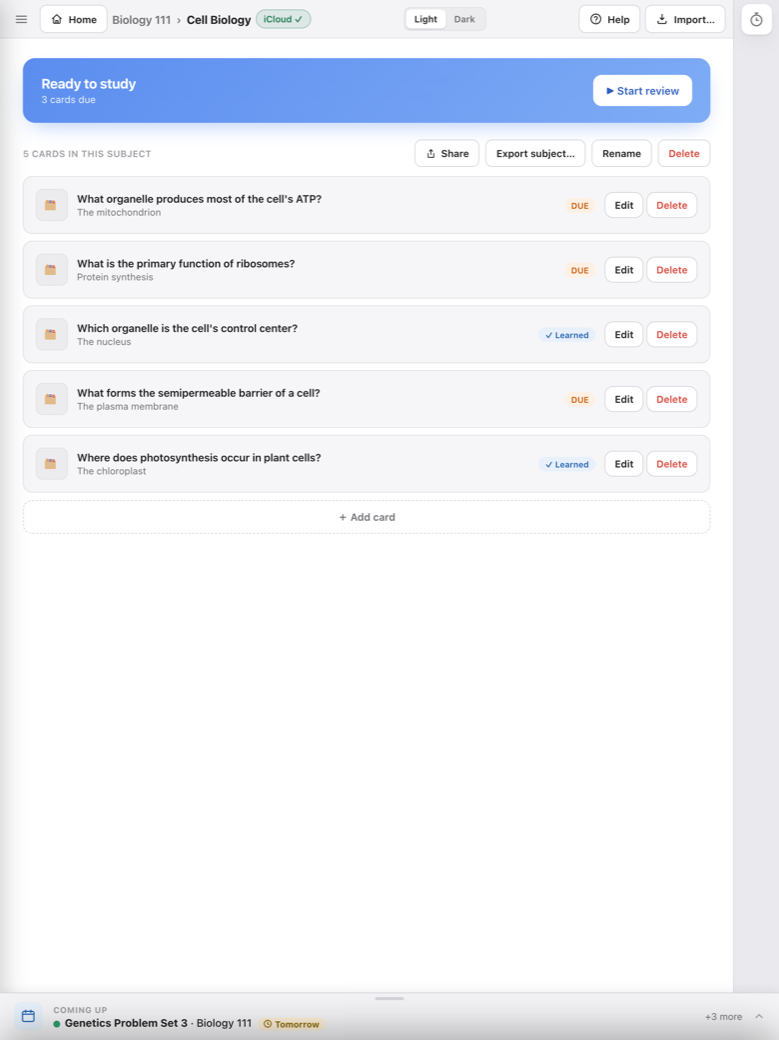
Reps organizes into classes, and each class contains subjects. Each subject has its own deck. The mapping that holds up over a full program is: class = the course as your registrar names it, subject = the unit that gets its own exam or its own coherent chunk of material.
A first-semester nursing layout
- Pharmacology I — Cardiovascular agents, Antimicrobials, Analgesics, Endocrine, Calculations
- Anatomy & Physiology II — Cardiovascular, Respiratory, Renal, Endocrine, Reproductive
- Fundamentals — Vital signs, Assessment, Infection control, Safety
- Med-Surg I — Cardiac, Pulmonary, GI, Neuro
Resist making subjects too small. A subject with eleven cards in it is noise on the home screen, and you'll have thirty of them by November. Too big is its own problem. One subject called "Pharmacology" holding six hundred cards gives you no way to see that you're behind on antimicrobials specifically.
The home screen leads with one number: cards due today across everything, broken out by class. On a heavy week that number is the only thing you need to look at.
When a block ends but the material comes back
This is where most people's decks fall apart. Cardio block finishes, you take the exam, and the temptation is to archive the cardio deck and start clean on renal. Six months later there's a comprehensive exam, and a year after that there's a licensing exam, and every card you retired is now a fact you don't have.
Don't retire it — leave it, and it's cheaper than it sounds. A cardio card you've answered right four or five times already sits on a multi-week interval, so it comes back only every few weeks. That's the whole cost. In practice, your daily due count in month four is your current block plus a thin layer of everything before it, and that thin layer is exactly what a cumulative exam pulls from.
One thing worth knowing about how the queue behaves. The study queue is shuffled, so cardio and renal and micro come at you interleaved rather than in neat blocks, which is closer to how a real question stem works anyway. More on the mechanics on the spaced repetition page.
Deadlines and prep bars on a block schedule
Coming up holds your exams and homework, each with a date and a live countdown running against it. Pharm midterm, eleven days. Micro practical, Thursday. Care plan due Sunday.
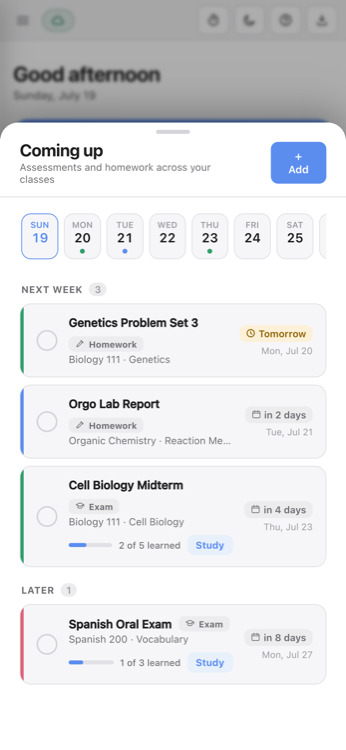
Every assessment gets a prep bar underneath, something like "34 of 96 learned" — counted from the cards in that subject that aren't due back yet, meaning the material currently sitting in memory rather than waiting in your queue. On a block schedule the bar is the useful signal: "I have eleven days" tells you nothing, but "eleven days and I'm at 34 of 96" tells you whether to worry.
Items check off when they're done. A block generates a lot of small deadlines. Quiz, lab report, practical, written. Checking them off is what keeps the list from turning into a graveyard of things you already handed in.
There's a focus timer as well, with four splits: 15/3, 25/5, 20/10, and 50/10, work minutes over break minutes. For dense reading, a patho chapter or a drug table, 50/10 tends to be the one. After every fourth completed block you get a longer break. The end-of-block chime can be muted, which is the setting you want in a library or a quiet room on a unit.
Studying in clinical downtime
Reps is fully functional offline, including airplane mode — not an incidental feature for anyone on clinical rotations. Hospital basements have no signal, and neither do a lot of stairwells, break rooms, and the twenty minutes you spend waiting for a preceptor. There's no server behind Reps at all: the due cards are already on the device, so you get through fifteen of them standing in a hallway. Sync runs through your own iCloud when you're back on a network, so the Mac you study on at home matches the phone in your scrub pocket.
Privacy, and why it matters more here
No account, no trackers, no analytics; the App Store label reads "Data Not Collected," because there's no server to collect anything to. Your cards go to your own iCloud and nowhere else — nobody at BSR LABS can see them. That matters more here than in most apps, because study notes in a clinical program get written next to real patients. Even careful people end up with a card that says "the CHF patient in 4B, why we held the metoprolol." That card goes to your iCloud and stops there.
Sharing a deck with your study group
A subject exports as a single .reps file that opens in a classmate's copy. Study groups split the block with this: one person writes the antimicrobials, one the cardiovascular agents, one the endocrine, and everyone trades files at the end of the week. You write one section instead of four — and because you have to actually read a card to answer it, you review your groupmates' work as you go.
What it costs and what it runs on
One payment of $6.99 USD, or $6.99 CAD in Canada, covers iPhone, iPad, and Mac through Universal Purchase. No subscription and no in-app purchases, which is a relevant point in a program where several of the standard study tools bill annually and the total gets ugly by fourth year.
- iPhone and iPad, iOS 14 or later
- Mac, macOS 10.15 or later, universal binary for Apple Silicon and Intel
- Light and dark mode
- Progress view: a bar for each of the last seven days showing cards reviewed, a study streak, and a count of cards that have passed the early intervals
You write your own cards, and for a lot of people in medicine and nursing that's the point. The writing is where you figure out what the fact actually is. If you'd rather download somebody else's twenty thousand cards, Reps is the wrong tool for you.
Get Reps on the iOS and macOS App Store
FAQs
What happens to a card I rate Again?
It goes to the back of the current pile and you see it again before the session ends. It does not disappear until tomorrow.
Can I tune the intervals for a heavy block?
No. SM-2 runs the scheduling and there is nothing to configure. If a block is heavy, that shows up as a higher due count, not as something you adjust.
Can I put a photo from my atlas on a card?
Yes, on the front, the back, or both, from the camera or your photo library. There's also a drawing pad with Apple Pencil support, and pressing harder gives a thicker line.
Does the app need a signal to work?
No. Reps works fully offline, airplane mode included. There is no server behind it. Sync runs through your own iCloud account when you're back on a network.
Can I share a deck with a classmate?
Yes. A subject exports as a .reps file, and sending that file to a classmate opens it in their copy of Reps.
Does it work on my Mac as well as my phone?
Yes. One payment of $6.99 USD, or $6.99 CAD in Canada, covers iPhone, iPad, and Mac through Universal Purchase. The Mac build is universal for Apple Silicon and Intel, and needs macOS 10.15 or later.
Is there a subscription?
No. One payment of $6.99 USD, or $6.99 CAD in Canada, covers iPhone, iPad, and Mac. No in-app purchases.